

Yield.xyz AgentKit Builder Skill
Overview
The Yield.xyz AgentKit Builder Skill is an Agent Skill that teaches any MCP-compatible AI agent to generate production-ready code for integrating with the Yield.xyz API. It turns a natural-language request, "build me a USDC lending dashboard," "integrate Lido staking into my wallet app," "generate a backend that enters Aave positions", into a working application, covering staking, lending, vaults, restaking, and liquid staking across 80+ networks.
Where the base yield-xyz-agentkit skill is for exploring and executing yields conversationally, the Builder Skill is for writing the code that ships in your product. It uses the MCP server to research the live API spec during the build session, but the code it generates calls the Yield.xyz REST API directly with the developer's own API key, so the generated app has no runtime dependency on MCP.
What This Skill Covers
The Builder Skill activates the moment a developer asks to build something:
- "Build me a staking dashboard with Next.js"
- "Integrate USDC lending into my wallet app"
- "Generate a backend that enters Aave positions"
- "Set up a neobank with DeFi yield features"
- "How do I sign Yield.xyz transactions with MetaMask?"
It covers the end-to-end integration surface:
- REST API integration — generates code against
https://api.yield.xyzwith the developer's own API key - Transaction lifecycle — discover → schema → action → sign → broadcast → submit-hash → confirm
- Wallet signing — MetaMask, Phantom, WalletConnect, Rainbow, Coinbase Wallet, plus multi-wallet abstractions (wagmi, Web3Modal, RainbowKit, ConnectKit, Solana Wallet Adapter, CosmosKit)
- Chain coverage — EVM, Solana, Cosmos, Tron, Substrate, Tezos, TON, Near, Sui, Aptos, Cardano, Stellar
- Production hygiene — pagination by default, server-side sort/search/filter, dependency vetting, env-var-based API keys
It does not execute transactions, hold keys, or call MCP action tools to look up data. All runtime data lookups go through the live REST API with the user's own key. (See "Architecture and Design Notes" below for why.)
How It Works
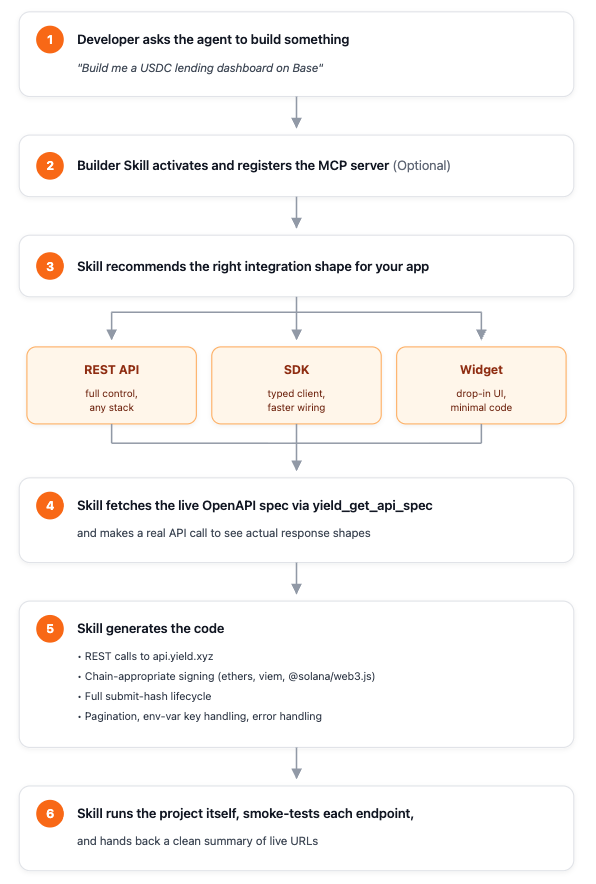
The skill handles everything up to a running, smoke-tested project. What you do next, deploy it, add auth, swap the wallet, wire up monitoring, is up to your integration.
Getting Started
No API key is required to install the skill itself. You'll need a Yield.xyz API key before the skill can generate working code, you can get one at https://dashboard.yield.xyz/sign-up/register-interest.
Install
In your terminal, run:
npx skills add stakekit/agentkit --skill yield-xyz-agentkit-builderThen open your agent and say:
Set up the yield-xyz-agentkit-builder skillThe agent reads SKILL.md and registers the AgentKit MCP server automatically.
To confirm the skill is active:
What skills and MCPs do you have connected?Architecture and Design Notes
REST-first, not MCP-first The skill deliberately avoids calling MCP action tools (yields_get, yields_get_all, actions_enter, etc.) during a build session. MCP responses are trimmed for chat context — they omit fields present in the full REST response. Code built against those trimmed shapes silently misses required data.
Instead, the skill generates code that calls https://api.yield.xyz directly, and during the build session it uses the developer's own API key to inspect real responses. The output is always faithful to the live API.
Spec-driven, not memory-driven Field names and schemas on the Yield.xyz API evolve continuously. The skill never relies on hardcoded field names from its training data. Before generating any code, it fetches the live OpenAPI spec (yield_get_api_spec or https://api.yield.xyz/docs.json) and cross-checks against a real API response. This means generated code continues to work after schema changes that would have broken memory-based generators.
Unsigned-by-default The skill never generates code that modifies unsignedTransaction. The API returns transactions to sign exactly as-is; modifying them — even to "fix" an amount or recompute gas — causes loss of funds. If something is wrong, the skill regenerates the action from scratch rather than patching the unsigned payload.
Pagination is a default With 2,900+ yields across 80+ networks, a UI that renders the full catalog is unusable. The skill ships pagination wired in from the first version — page size, next/prev, preserved filters across pages, total count, server-side sort/search/filter through the API. This is the default, not a feature request.
Supply-chain cautious Every added dependency is a supply-chain risk. The skill defaults to the smallest possible dependency set, prefers the standard library, prefers packages already implied by the stack, and verifies weekly downloads, maintainer reputation, and recency before installing anything the developer didn't explicitly request.
Port-respectful When a local dev server hits a port conflict, the skill doesn't kill whatever is already bound to it — your other project, your local database, whatever. It tries the default port, falls back to the next common free port, and only asks before killing as a last resort.
What's Next
| Resource | Link |
|---|---|
| Claude Plugin | https://docs.yield.xyz/docs/claude-plugin |
Updated 3 months ago