

One key and one flow
Each product has its own API, but all three use the same API key and the same flow, whether the user is staking, trading or borrowing: find an opportunity, request an action, sign the transactions that come back, and track the result. Once you have integrated an API, every protocol, network or venue Yield.xyz later adds to it becomes available with no further integration work, and you choose which ones to switch on. The APIs were designed to be easy to integrate. Most actions need only three inputs: the opportunity’s ID, the user’s address and an amount. Each opportunity declares any other inputs it accepts, such as a validator, so your app can build its forms from that schema without hard-coding each protocol.Integrations Yield.xyz maintains
Yield.xyz builds and maintains every protocol integration, so your code doesn’t have to change when a protocol does. It monitors each integration for contract upgrades and keeps the reward rates, TVL, prices, limits and fees behind every opportunity accurate.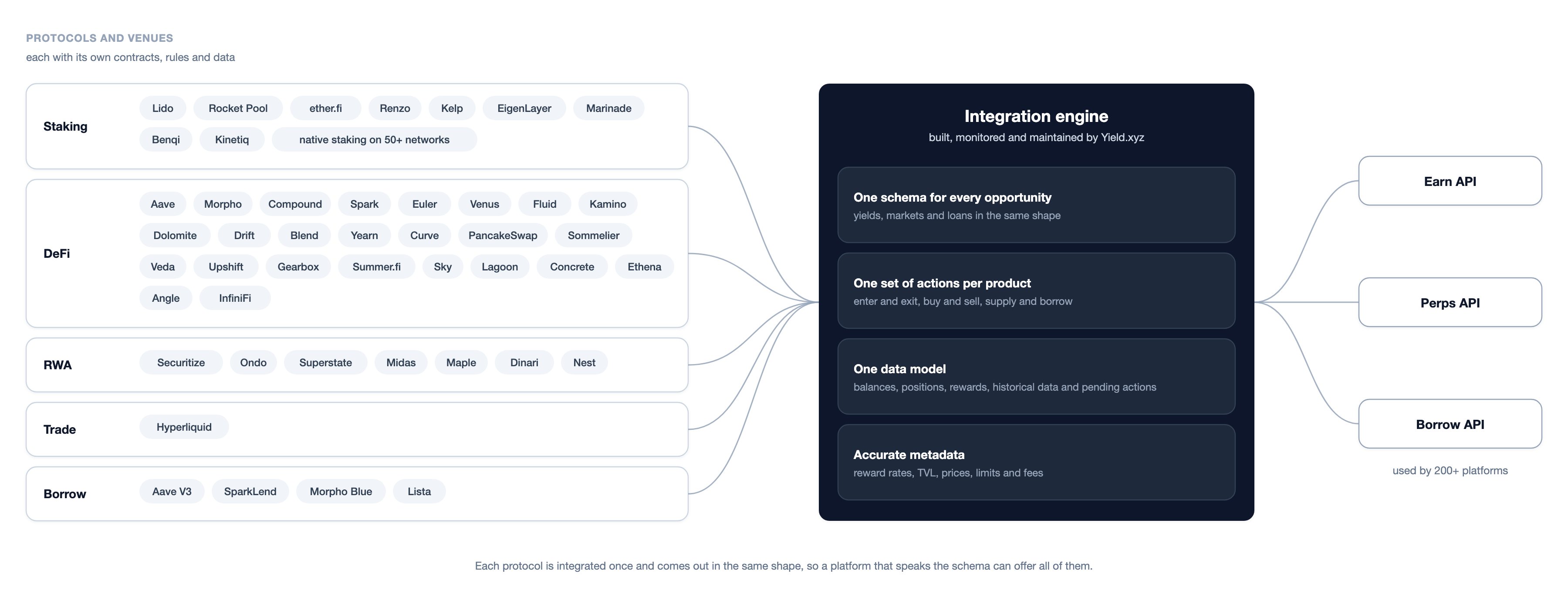
Funds stay visible
Funds stay visible for their whole lifecycle. From the moment a user deposits, the API reports where the funds are, from a confirming transaction through staking, unstaking and cooldowns to ready to withdraw. It also returns the pending actions the user can take, such as claiming rewards or withdrawing once a cooldown ends. A user can always see where their money is and what it takes to get it back. Each Yield.xyz product returns the data needed to build the user experience:- Earn: Reward rates and how they break down, TVL, entry limits, cooldowns and fees for every yield, with risk ratings aggregated from third-party raters for the yields they cover. For each wallet, balances by state and rewards earned.
- Trade: Mark price, funding rate, open interest, volume, allowed leverage and price candles for every market. For each user, positions with PnL and liquidation price, and open orders.
- Borrow: Borrow and supply rates, liquidity, utilization, maximum LTV and liquidation threshold for every market. For each user, collateral, debt, health factor and how much more they can borrow.
Fees on every product
You set your own fees on every product, and they are paid to you on-chain. On top of these fees, you receive a share of the revenue earned by validators and vault curators.
For Earn, Monetization explains the available fee models, while OAVs covers the vaults that collect them.
You can also add a time-limited reward budget on top of a yield with Incentive campaigns. Rewards accrue on time-weighted balances and are paid out from the campaign’s multi-sig.
Zero trust by design
You keep your keys and sign every transaction yourself. Yield.xyz builds each transaction and hands it back unsigned, and your application, wallet or custody provider signs it, then either broadcasts it or returns it for Yield.xyz to submit. Yield.xyz never takes custody of user funds or holds private keys. Before you sign, Shield can check the transactions Yield.xyz builds against their verified pattern, down to the target contract, the receiver, the spender and the calldata. Shield is open source, so you can audit exactly what it checks. You can run it inside your own app, and it also runs inside the Earn API as Defense Mode, which can block failing transactions for a project. Sentinel Vaults watch their strategy for exploits and depegs. When their monitoring confirms a risk, they pause within seconds, then withdraw the capital from the strategy and can move it into a pre-approved fallback.Security and compliance
Yield.xyz holds a SOC 2 Type II report. Its smart contracts are audited by Zellic and Spearbit/Cantina, and the platform has been penetration-tested by Spearbit/Cantina and Trail of Bits. You can also restrict access by region with API-level geoblocking, without changing your custody or signing setup.Start building
You can integrate directly with the APIs and SDKs, use embeddable components, or build with AI development tools and AgentKit. Start with the Quickstart to configure your project and make your first request.Quickstart
Create a project, generate an API key, and make your first API request.
Explore the APIs
Review the available endpoints, request parameters, and response schemas.
Security & Shield
Learn how Shield checks the transactions Yield.xyz builds against their verified pattern before you sign.
Build with AI
Use AI coding assistants, MCP and AgentKit to build your integration.